
What the Put-Call Ratio actually tells you (and what it doesn't)
The Put-Call Ratio is one of the first indicators new options traders adopt and one of the last they learn to use well. The folk rulebook — "high PCR is bullish, low PCR is bearish, because it's contrarian" — is not exactly wrong, but it is applied with a rigidity the indicator never earned.
The deeper problem is that PCR is a single number standing in for a distribution. An options chain contains dozens of strikes, each carrying its own story about who is positioned where and why. Collapsing all of it into one ratio discards nearly everything that made the chain informative, and what survives the collapse is easy to misread.
Two PCRs, often confused
There are two common constructions and they answer different questions:
- PCR by open interest compares puts and calls outstanding. It is a snapshot of positioning — where protection and bets have accumulated over days or weeks.
- PCR by volume compares puts and calls traded in a window. It is a snapshot of the day's flow — what is being put on right now.
Quoting "the PCR" without saying which one you mean is the first place the analysis goes wrong. They can point in opposite directions on the same day, and that disagreement is itself information: heavy put volume against a falling put-heavy OI base is closing activity, not new fear.
A third distinction gets ignored almost universally. Index PCR and single-stock PCR are not the same measurement. Index options carry an enormous, permanent hedging demand — portfolios buy index puts as insurance regardless of any directional view. Single stocks carry far less of that. The same numerical reading means different things in the two contexts, and index PCR sits structurally higher for reasons that have nothing to do with sentiment.
What the ratio hides
Every option has a buyer and a writer. The ratio counts contracts, not conviction, and it cannot tell you which side of those contracts represents the informed view.
Consider a single number — say a put-heavy reading on the Nifty chain — and the incompatible stories it is consistent with:
- Traders are buying puts because they expect a fall. Bearish.
- Institutions are writing puts at a level they are happy to be assigned near, collecting premium. Constructively bullish — put writing at a strike is a statement that the writer does not expect price below it.
- A fund is hedging a large cash position it fully intends to keep. Directionally neutral; it says more about position size than about market view.
- Someone is running a spread, where the put leg exists only to finance or cap another leg. The put is structural, not an opinion.
The ratio is identical in all four cases. This is the single most important thing to understand about PCR: it measures where contracts sit, not what anyone believes.
Why the contrarian story is incomplete
The contrarian reading assumes the crowd is wrong at extremes — that everyone loaded up on puts marks a bottom. Sometimes it does. But a high PCR can also reflect heavy, informed hedging ahead of a real risk event, in which case it is not a fade signal at all. The ratio cannot tell you on its own whether the puts are panic or prudence.
The contrarian logic also contains a hidden assumption that rarely holds: that the option buyers are the crowd and the writers are the smart money. In practice the composition varies by instrument and by moment. Institutional desks buy protection; retail writes premium in calm markets. Assuming a fixed hierarchy of who is on which side is exactly the kind of unexamined premise that makes an indicator feel reliable while it quietly stops working.
Levels are relative, not absolute
Most PCR rulebooks quote fixed thresholds — below 0.7 is complacent, above 1.5 is extreme. These bands are not laws. They are descriptions of a distribution that shifts with instrument, market regime and market structure.
A reading of 1.3 is unremarkable in one environment and stretched in another. What matters is where today's number sits relative to its own recent range for that instrument, not against a threshold borrowed from a different market or a different decade. If you are going to use bands at all, derive them from the series you are actually trading, and revisit them as structure changes — new expiry conventions, new participant mixes and changing lot sizes all move the baseline.
Strike and context matter more than the level
A PCR read across the whole chain blurs together very different things. Put open interest piling up at a specific strike below spot is a support story; the same ratio spread thinly across many strikes is not. The level of the ratio is far less informative than where the open interest sits relative to price, and how it is shifting session to session.
This is why strike-level open interest is more useful than the aggregate ratio for most practical purposes. The heaviest put strike below spot and the heaviest call strike above it describe a range the options market is actively defending — writers at those strikes have a direct financial interest in price not crossing them. That is a concrete, mechanical reason for levels to matter, which is more than can be said for the aggregate ratio.
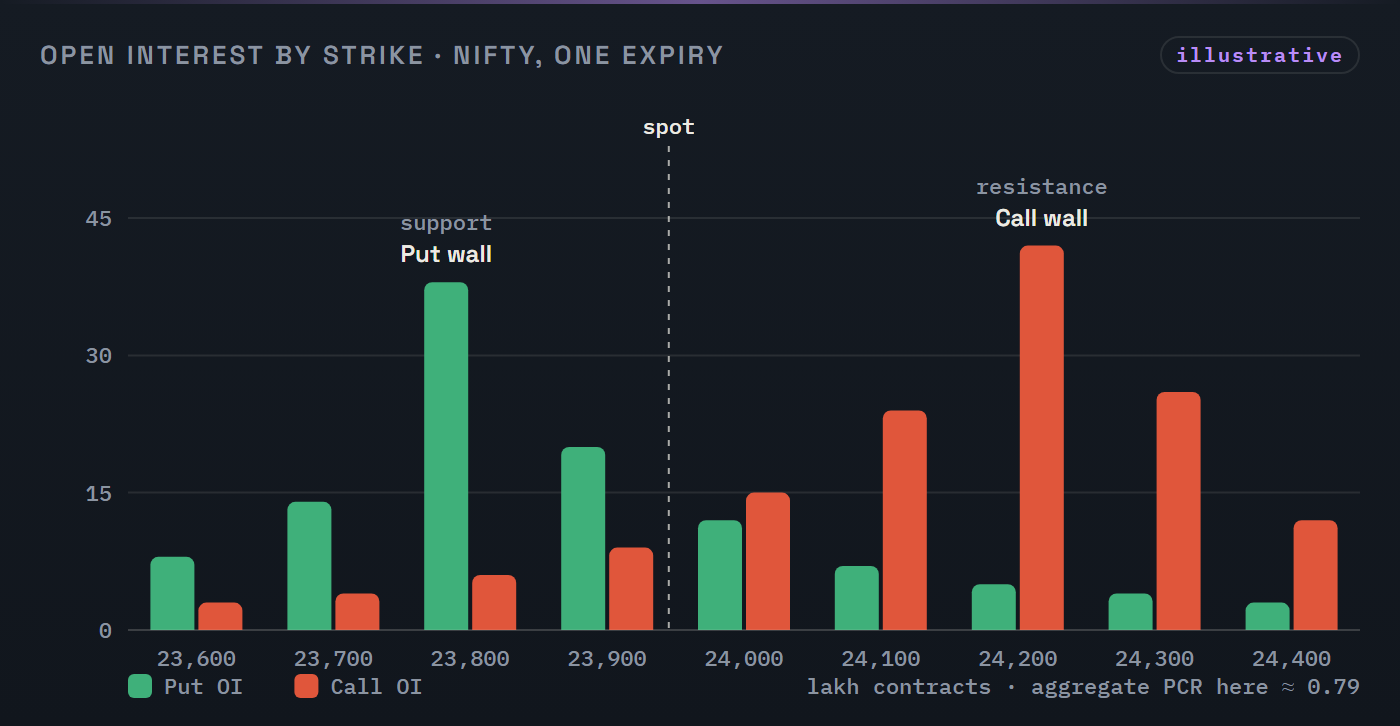
Illustrative. The aggregate ratio for this chain is about 0.79 — one number that says nothing about the two walls that actually matter.
The change matters more than the level, too. A put wall building at a strike over several sessions is a different signal from one that has sat there for a fortnight, and a wall that dissolves as price approaches was never a wall at all.
The expiry cycle distorts everything
PCR is not stationary across the life of a contract, and treating it as though it were is a common and expensive error.
Early in a cycle, open interest is thin and each new position moves the ratio disproportionately. Late in a cycle, positions are closed or rolled for reasons that have nothing to do with any view — the OI drains, the denominators shrink, and the ratio becomes erratic precisely when people are watching it most closely. On expiry day itself the number is close to meaningless.
Around scheduled events — policy decisions, results, major data — the chain fills with positioning that is explicitly temporary. The ratio moves, and it is describing an event hedge, not a directional stance.
If you track PCR at all, track it at a consistent point in the cycle. Comparing a fresh-contract reading against a near-expiry one is comparing two different measurements that happen to share a name.
Using it without overusing it
- Treat PCR as context, not trigger. It frames the positioning backdrop; it does not, by itself, time entries.
- Always specify OI or volume, and note when they disagree.
- Never compare index and single-stock readings as if they were the same scale.
- Read it against price and key strikes, not as a free-floating number with a fixed bullish/bearish threshold.
- Prefer the strike-level picture to the aggregate whenever you actually need to make a decision.
- Hold the expiry cycle constant when comparing readings across time.
Like most sentiment measures, PCR is most useful when it confirms or complicates a thesis you already hold for other reasons — and least useful when it is the thesis.
Want a strategy like the ones discussed here built and validated? See the service →