
Reading FII and DII flows without fooling yourself
Few numbers get quoted with more confidence and understood with less care than the daily FII and DII provisional figures. A green FII number becomes "smart money is buying"; a red one becomes "foreigns are dumping India." Both readings are usually wrong, or at least premature.
The figures are not bad data. They are narrow data doing duty as a general-purpose explanation, which is a different problem and a harder one to notice.
What the number actually is
The headline figure is a net provisional cash-market number released after the close — gross buys minus gross sells, before later revision, and excluding large chunks of activity that happen through other routes. It is a single day's net, in one segment, subject to correction. Treating it as a clean readout of institutional conviction asks far more of it than it can deliver.
Three specific limitations are worth holding in mind.
It is provisional. Revised figures follow, and they do not always agree with the print that generated the day's headlines. The commentary is written against the provisional number and almost never updated.
It is net. A flat net print can conceal enormous two-way gross activity — heavy buying and heavy selling that happened to cancel. "Nothing happened today" and "an ownership transfer happened today" produce the same headline number, and they are not the same market.
It is one segment. The exchange cash market is not the whole of institutional activity. Primary-market participation, block deals and off-market routes follow their own reporting, and the daily provisional series is not designed to capture the complete picture. A large IPO allocation can make a period look very different depending on which series you read.
"FII" and "DII" are buckets, not actors
The single greatest source of confusion is grammatical. We say "FIIs are selling" as though FIIs were a person with a view. They are a reporting category containing participants with almost nothing in common.
Inside the foreign bucket sit long-only funds acting on a multi-year allocation decision, hedge funds trading a two-week thesis, index trackers mechanically rebalancing to a benchmark, and desks executing arbitrage where the cash leg is only half of a position. A benchmark reweighting can produce hundreds of crores of "FII selling" that expresses no opinion about India whatsoever.
The domestic bucket is at least as mixed: mutual funds, insurers, pension money and banks. And a large share of domestic mutual fund buying is structurally committed — recurring monthly contributions arrive and must be deployed largely regardless of whether the manager finds prices attractive. That flow is closer to a mechanical inflow than a judgement call.
This matters enormously for interpretation. Persistent DII buying against persistent FII selling is often read as domestic conviction defeating foreign pessimism. Frequently it is one bucket making an active decision and the other executing a standing instruction. Those are not opposing views; they are different kinds of thing entirely.
The cash-only blind spot
The daily figure everyone quotes covers the cash market. Institutional positioning also lives in derivatives, and the two can tell opposite stories on the same day.
Participant-wise open interest data — the split across foreign, domestic, proprietary and client categories in index and stock futures and options — is published alongside, and it is where a large part of directional and hedging positioning actually sits. A desk can be a net cash seller while building a long futures position, or a net cash buyer while heavily hedged. Reading the cash print alone and calling it "positioning" is reading one leg of a two-legged trade.
This is the single cheapest upgrade available to anyone who follows these numbers: look at the cash print and the derivatives positioning together, or do not draw conclusions about direction at all.
Three honest uses
Despite the noise, the series is not useless. Used carefully it gives you three things:
- Persistence, not single prints. One day is noise. A multi-week run of consistent FII selling against DII absorption is a structural fact about who is on which side. The signal lives in the streak, not the headline.
- Divergence between the two. When FIIs sell persistently and DIIs absorb persistently, you are watching a transfer of ownership rather than a simple sell-off. That tends to matter more for how the market falls — orderly versus disorderly — than for whether it falls.
- Context for index moves. A sharp index day on heavy net flows reads differently from the same move on thin flows. The flow number is a denominator for conviction, not a standalone signal.
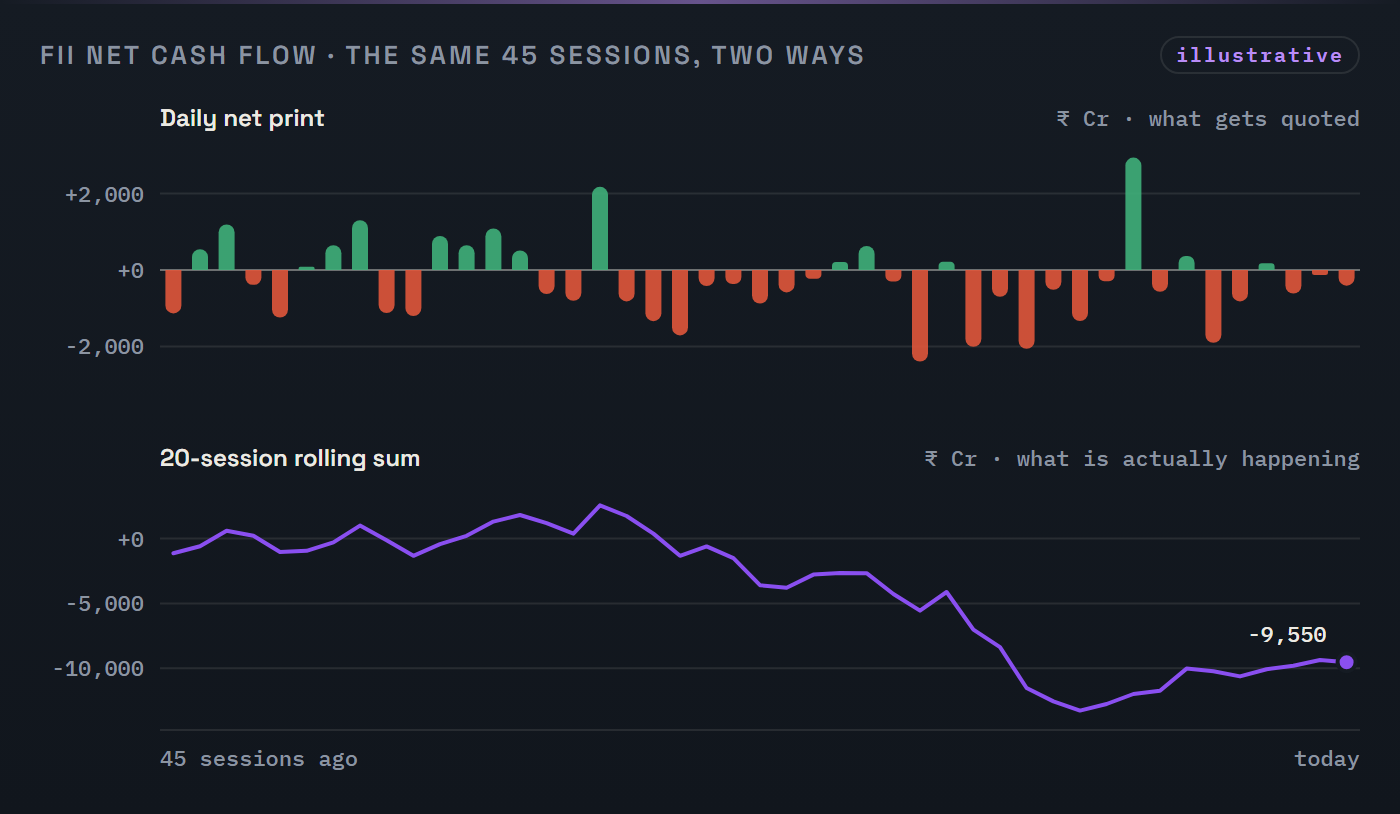
Illustrative. Same sessions, same data. The daily prints invite a new story every evening; the rolling sum shows one thing happening.
To these it is worth adding a fourth, quieter use: the series is good at telling you when a popular narrative is false. "Foreign money has abandoned India" is a claim that a rolling flow sum can check in seconds. Using the data to falsify stories is a far better fit for its resolution than using it to generate them.
Where people fool themselves
- Same-day causation. Attributing today's index move to today's flow number ignores that the move and the flow are both outputs of the same session. Neither caused the other; both describe it.
- Cash-only tunnel vision. Index and stock futures positioning can tell a different story than the cash print. Reading one without the other invites confident, wrong conclusions.
- Ignoring the float. Whether DII buying can absorb FII selling depends on magnitudes relative to traded value, not on the raw rupee figure in isolation. A number that sounds enormous in absolute terms may be routine as a share of the day's turnover.
- Treating rupee figures as comparable across years. Market capitalisation and daily turnover have grown substantially. A flow figure that represented a significant share of activity some years ago may be unremarkable today. Compare shares, not headlines.
- Mistaking mechanical flows for opinions. Index reweightings, fund launches and redemption pressure all move the number without anyone forming a view on valuation.
A workflow that respects the data
Track the rolling sum, not the daily print. A twenty-session cumulative figure removes most of the noise that generates most of the commentary, and it is the horizon at which the series starts describing something real.
Watch FII and DII as a pair. The relationship carries more information than either line alone, and the interesting states are the ones where they diverge persistently rather than the days when one is merely large.
Pair cash flows with derivatives positioning before drawing any conclusion about direction. If you only ever adopt one habit from this piece, make it this one.
Normalise where you can. Flows as a proportion of traded value are comparable across time in a way that rupee crores are not.
And hold the interpretation loosely. The honest summary of what this data supports is narrow: who has been on which side, over a period of weeks, in one segment, subject to revision. That is genuinely useful. It is also considerably less than what it gets asked to prove every evening.
The flow series rewards patience and punishes the urge to narrate every single day.
Want a strategy like the ones discussed here built and validated? See the service →